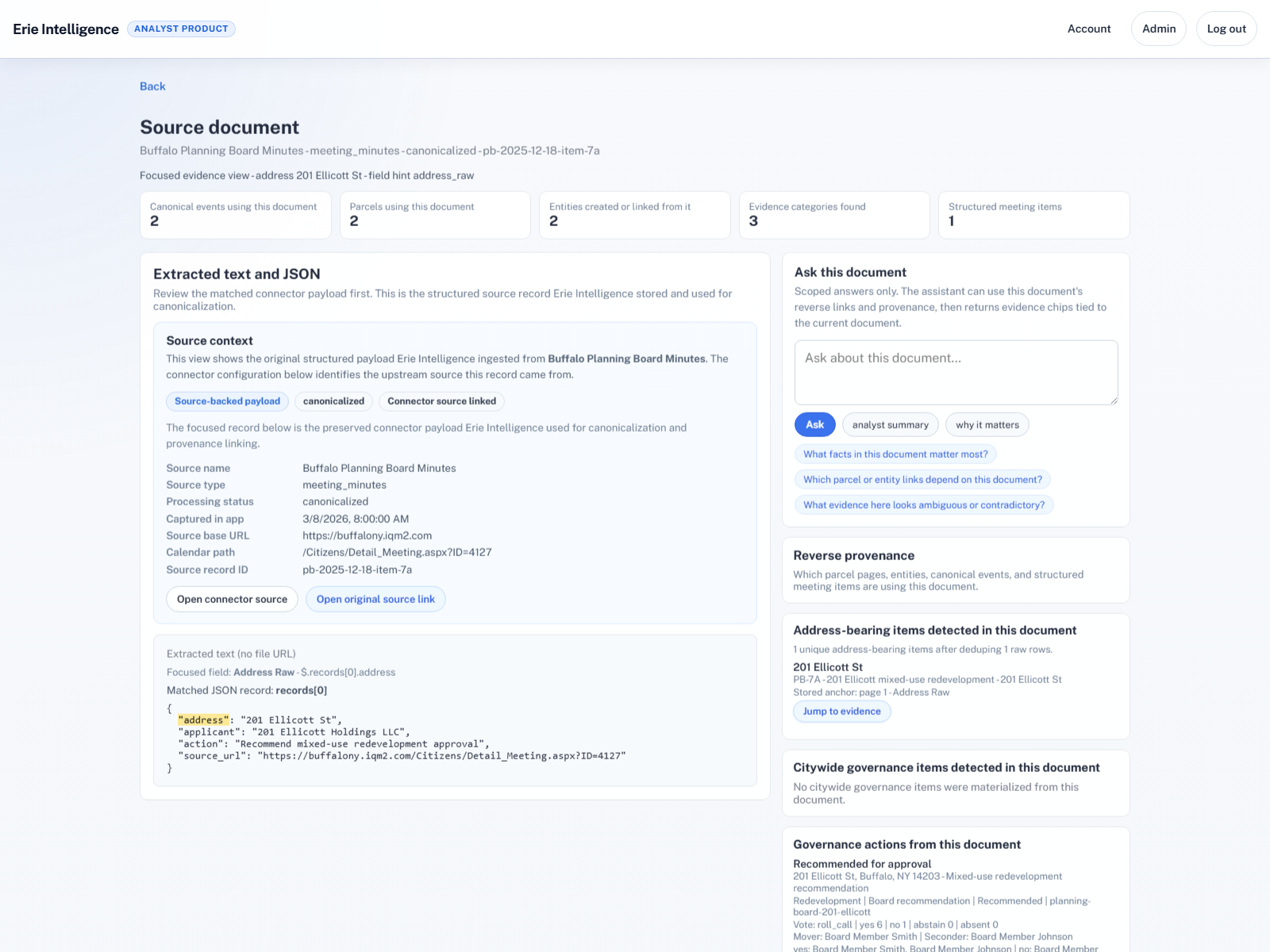
Actual source-evidence view
See the property record, graph, and source evidence working together instead of a static list of fields.
License ownership-oriented parcel datasets with linked permits, violations, planning signals, and entity context for research, underwriting, outbound, and operational workflows.
See the property record, graph, and source evidence working together instead of a static list of fields.
Erie Intelligence is built for teams that need parcel, owner, municipal, and document context in one local workflow, not another generic property-data experience.
Recurring ownership delivery for Western New York needs mailing structure and parcel joins your systems can trust.
Downstream models choke when related parties and addresses are not normalized to how you operate.
Dataset consumers need refresh semantics and keys that survive audits—not one-off dumps.
License structured ownership intelligence aligned to Erie County and Buffalo coverage, not a national grab bag.
Keep parcel-to-owner joins, mailing details, and supporting local structure clean enough for real operational use.
Layer permit, violation, planning, and related-entity context onto ownership data so the record becomes more actionable.
Deliver ownership datasets into CRMs, internal systems, and recurring data workflows without a separate cleanup project.
Ownership delivery rides the same public coverage logic as the rest of the site: county-wide parcel base, Buffalo-first municipal depth, and explicit disclosure where source-family coverage is partial or planned.
Parcel coverage is county-wide across 44 municipalities. Municipal activity depth is Buffalo-first today with expanding source-family coverage elsewhere.
Buffalo is the deepest municipal workflow today, with permit records from January 2, 2007 onward and code-violation history from March 28, 2016 onward. Newest permits may have an official holdback of roughly two weeks.
Additional municipality support rides the same county-wide parcel spine, but source-family depth is intentionally uneven and disclosed publicly rather than implied.
Reduce the spreadsheet work needed to make ownership records usable for targeting, portfolio work, and internal operations.
Tie ownership records back to permits, violations, and planning activity instead of leaving them as static list data.
Use exports, licensing, and API delivery paths that fit downstream systems without changing the product story.
Position the dataset as a local intelligence layer, not just a file of property owners and mailing addresses.