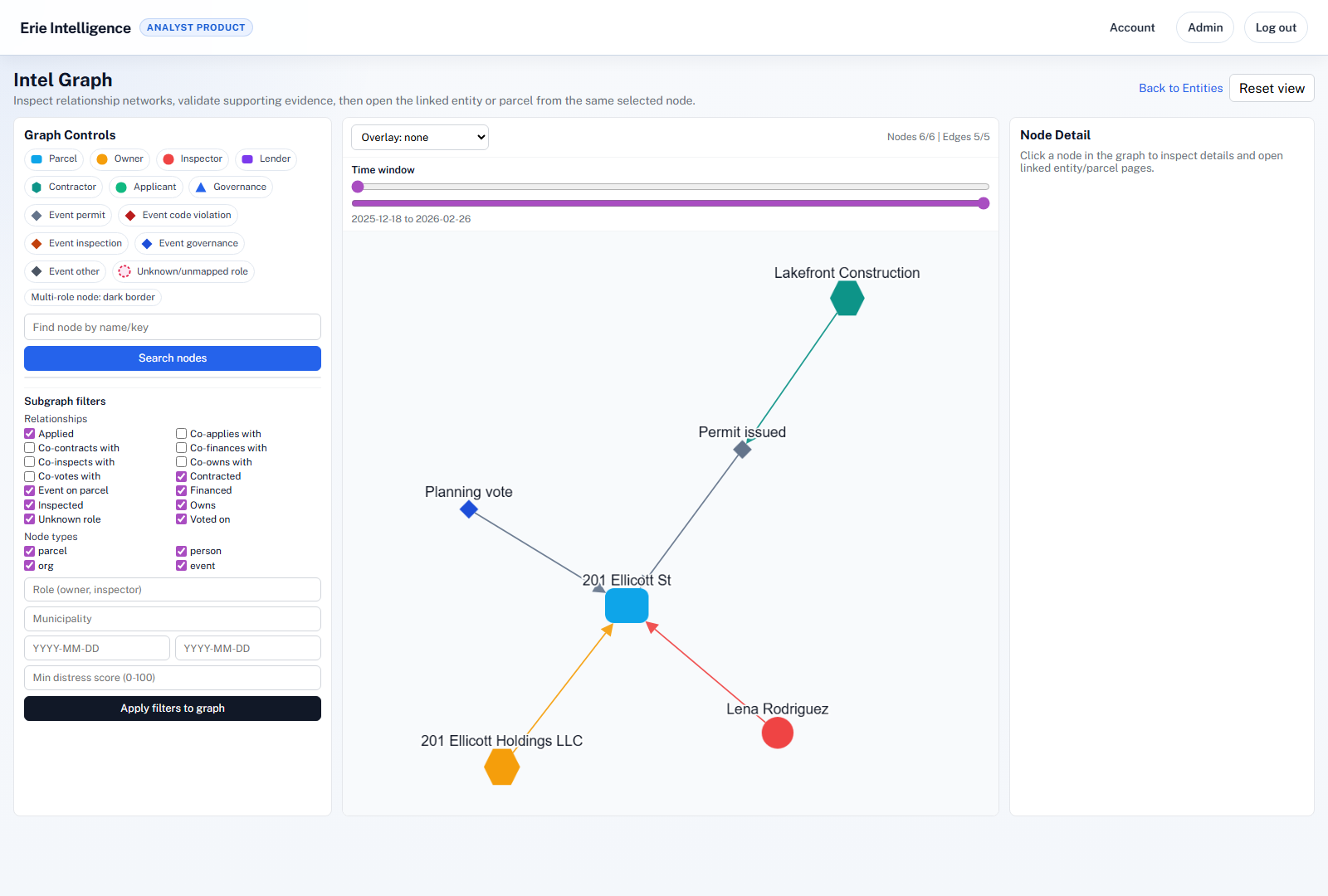
Actual graph workflow
See the property record, graph, and source evidence working together instead of a static list of fields.
Use a Buffalo-focused property dataset to monitor ownership changes, permit activity, code issues, planning history, and development patterns at parcel level.
See the property record, graph, and source evidence working together instead of a static list of fields.
Erie Intelligence is built for teams that need parcel, owner, municipal, and document context in one local workflow, not another generic property-data experience.
Buffalo’s municipal stack rewards teams that can move from parcel to planning and enforcement signals without losing the thread.
National layers skip the behaviors agencies and neighborhoods actually exhibit season to season.
Canvassing, listing prep, and risk review break when everyone references a different snapshot.
Keep parcel-led context, municipal events, and documents in one surface tuned for serious Buffalo work.
Ground the workflow in an address and parcel record that stays usable for analysts, operators, and local market teams.
Bring code, permit, planning, and ownership changes into one local view so teams can understand the property story faster.
Use Buffalo coverage inside the app, in repeatable exports, or as part of a broader commercial delivery path.
Buffalo is the deepest municipal workflow today. The matrix below makes the source limits public, including the known date ranges and lag notes that buyers usually have to discover on their own.
Buffalo permits run from January 2, 2007 to present, with an official note that the newest permits may omit roughly the most recent two weeks.
Code-violation history starts March 28, 2016; related public-record families such as housing court and rental registry have their own historical start dates and should be interpreted with those source limits in mind.
Support neighborhood-level work with cleaner parcel, address, and owner structure than scattered public sources provide.
See permits, code activity, and planning context in the same workflow rather than spread across separate city interfaces.
Move from parcel records into owner, mailing, and relationship analysis with less manual cleanup.
Keep Buffalo coverage useful across acquisitions, brokerage, municipal operations, servicing, and data licensing paths.
These pages show how the public stack behaves, where the joins break, and what a stronger local operating layer looks like in practice.
Explains the difference between Buffalo public data access and Erie Intelligence as a joined parcel workflow.
Step-by-step guide to moving from a Buffalo parcel into owner, permit, code, planning, and evidence context.
Clarifies when a national parcel tool is enough and when local workflow depth creates the better fit.